
Yangwang U9 Track Edition: China’s Electric Hypercar Takes Aim at the Track
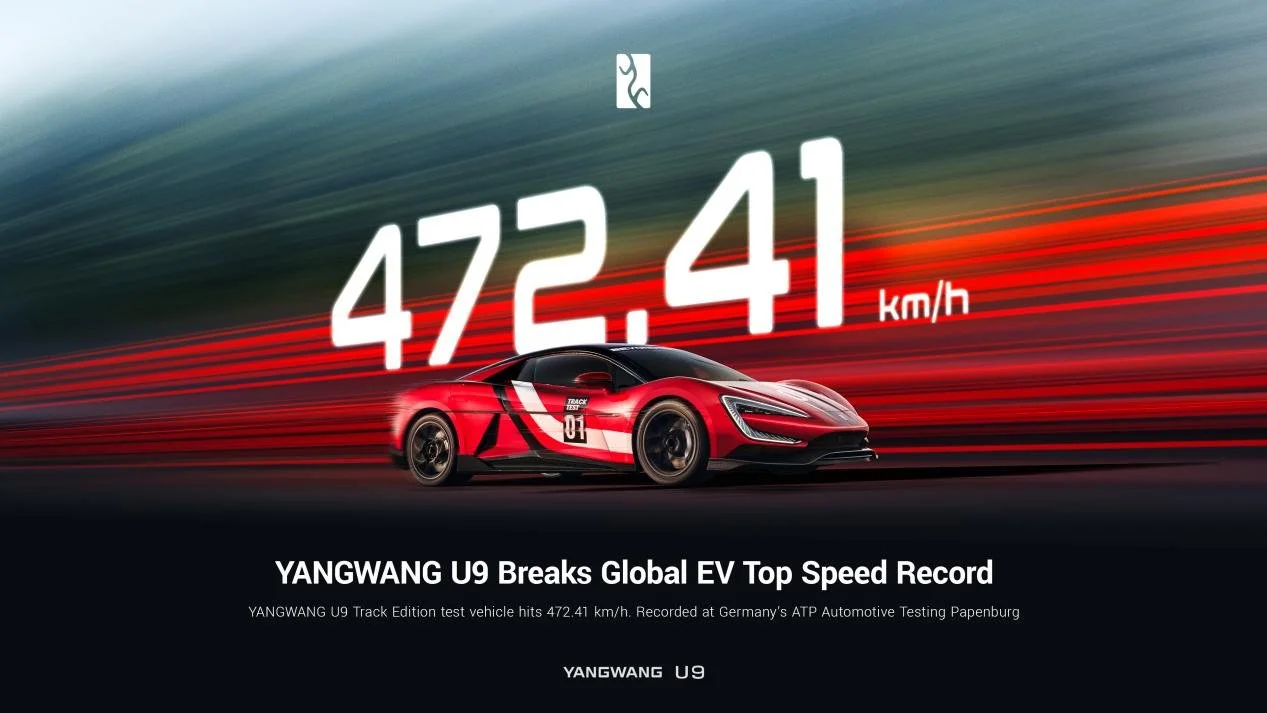
Image: BYD Auto Industry Co., Ltd
Chapter 1: A New Era for Chinese Performance Engineering
On 8 August 2025, at the ATP Automotive Testing Papenburg track in Germany, the Yangwang U9 Track Edition hit 472.41 km/h and set a new global top-speed record for electric vehicles. Officially confirmed by BYD, this run makes the U9 Track Edition the world’s fastest EV and moves China straight into the top tier of extreme performance engineering.
The car itself is built on the same e⁴ Platform and DiSus-X body control architecture as the road-going Yangwang U9 already on sale in China. What changes for the Track Edition is the level of extremity: it debuts the world’s first mass-produced 1200-volt ultra-high-voltage platform combined with a thermal-management system specifically optimized for operations far beyond normal road use.
Each of the four 30,000-rpm high-performance electric motors delivers up to 555 kW, for a combined system output of more than 3,000 PS and a power-to-weight ratio of 1,217 PS per tonne – numbers that put the U9 Track Edition directly into the same performance orbit as the most extreme hypercars on the planet, regardless of badge.
And yet, strictly by price, the U9 still undercuts the traditional hypercar field. The standard Yangwang U9 launched in China at around 1.68 million yuan – roughly 215,000 euros – far below the classic one-million-euro threshold many enthusiasts unofficially associate with hypercar status. Even if the Track Edition carries a substantial premium, it remains in a different price class than the ultra-limited European exotics. That is exactly what makes it so disruptive: it delivers record-breaking performance without record-breaking pricing.
The speed record run itself was not a PR stunt at modest speeds. At 472.41 km/h, German professional driver Marc Basseng – who already held the previous EV top-speed record – had to rely on the full capabilities of the e⁴ torque-vectoring system and DiSus-X body control to keep the car stable, with the chassis continuously managing body posture and tyre contact at over 100 adjustments per second.
So while traditionalists may still hesitate to label a sub-million-euro Chinese EV as a “hypercar”, the data says something else entirely. With over 3,000 PS, a 1200-volt architecture and a verified 472.41 km/h top speed, the Yangwang U9 Track Edition forces the industry to reconsider what defines the top of the performance pyramid – and who gets to stand there.
Chapter 2: Design & Aerodynamics Purpose-Built for the Circuit
The Yangwang U9 Track Edition takes the already aggressive design language of the standard U9 and turns it into a weapon specifically engineered for circuit performance. While the road car already pushes boundaries with its sharp lines, deep channels, and active aerodynamic elements, the Track Edition abandons all compromise. Every modification serves a functional purpose, driven by airflow efficiency, cooling optimization, and high-speed stability.
One of the most striking changes is the significantly enlarged aerodynamic package. The front splitter is deeper and wider, managing airflow with far more authority than the street version. It directs air under and around the body to reduce turbulence while simultaneously generating high levels of downforce that keep the front axle planted under extreme braking. The side aero is equally purposeful. Larger venting and sculpted intakes ensure that the quad-motor system remains thermally stable during extended high-load conditions, something essential for a track-oriented EV where heat management is often the limiting factor.
At the rear, the Track Edition features a fixed motorsport-style wing—much more substantial than the active rear wing found on the standard U9. This choice prioritizes predictability and constant downforce over variable aerodynamic response. Combined with a more aggressive rear diffuser, the Track Edition is designed to keep the vehicle stable even at the extreme speeds expected from a 3,000-horsepower electric hypercar contender. The aero surfaces work in unison to create a balanced distribution of downforce, enabling sharper turn-in behavior and improved mid-corner stability.
The material philosophy also shifts toward uncompromised performance. Carbon fiber is used more extensively, reducing weight and increasing chassis rigidity—a critical aspect given the intense forces generated by four independently controlled electric motors. Cooling ducts, brake channels, and battery ventilation pathways are all reworked to withstand repeated track sessions without thermal degradation.
Visually, the U9 Track Edition still resembles the road car, but the details reveal a deeper truth: this is no longer a design exercise meant to look fast. It is engineered to be fast, consistently, under the harshest conditions a circuit can impose. Function defines every line, and performance dictates every surface. Yangwang is not copying European hypercar design—it is defining its own aerodynamic identity with clear, measurable intent.
Chapter 3: Powertrain & Suspension Innovations
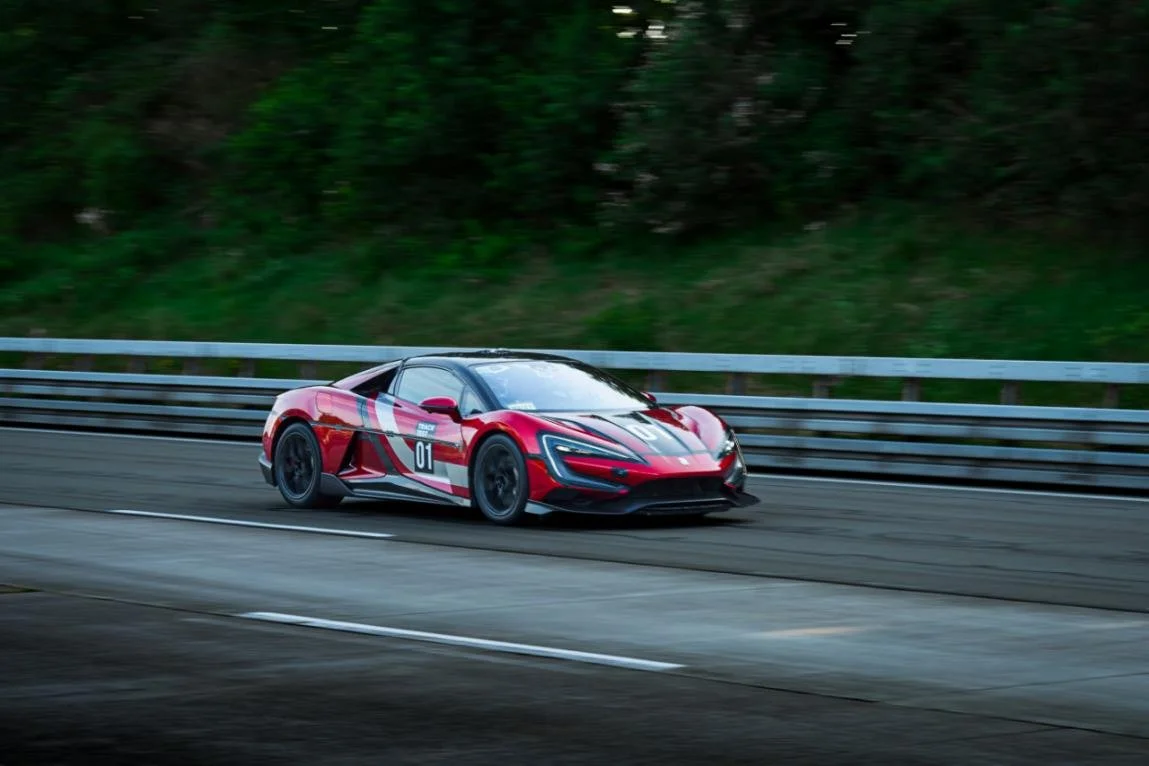
Image: BYD Auto Industry Co., Ltd
At the core of the Yangwang U9 Track Edition lies one of the most advanced electric powertrain architectures currently in production: BYD’s e⁴ quad-motor platform. Each wheel is powered by its own electric motor, allowing completely independent torque distribution in real time. This is not marketing language—the system can manipulate traction, rotation, and stability with a level of precision that traditional mechanical differentials cannot match. It effectively turns the chassis into a software-defined performance tool.
Early disclosures indicate that the Track Edition will exceed the output of the road car, pushing total system power toward or beyond the 3,000-horsepower threshold. While exact figures have not yet been released, the hardware is fundamentally capable of such output. Combined with instant torque delivery, the U9 operates in a performance realm previously reserved for extreme prototypes rather than production vehicles.
Power is nothing without control, and this is where the U9’s torque vectoring becomes a defining characteristic. By directing torque independently to each wheel, the system can correct oversteer, tighten cornering lines, and stabilize the car under heavy braking—all without relying on mechanical intervention. For track driving, this translates into repeatable, ultra-fast responses and the ability to push the car deeper into corners with confidence.
The suspension system of the Track Edition moves even further away from roadgoing comfort and into motorsport territory. The standard U9 features BYD’s DiSus-X intelligent hydraulic suspension with dramatic abilities, including active body control and high-speed stabilization. For the Track Edition, this setup is recalibrated toward rigidity, reduced roll, and maximum lateral grip. The system can alter damping forces in milliseconds, allowing the car to remain flat even under extreme load transitions.
Braking is equally critical in a vehicle with this level of performance. Expect enlarged carbon-ceramic components and recalibrated brake cooling systems to withstand repeated high-energy stops. Because electric motors can also provide regenerative braking, the U9 blends mechanical and electrical deceleration to maintain consistent performance across long sessions.
Together, the powertrain and suspension form a unified performance ecosystem. The U9 Track Edition isn’t simply powerful—it is engineered to convert that power into controlled, repeatable, track-focused performance. This is where the vehicle moves from being a fast electric car to a genuine contender in the hypercar arena.
Chapter 4: Track Performance – Built for Real Circuit Demands
The Yangwang U9 Track Edition is engineered with one clear objective: consistent, repeatable performance on a race circuit. Unlike many high-performance EVs that deliver astonishing acceleration figures but struggle with heat management, brake fade or power roll-off during extended sessions, the Track Edition is designed to withstand the stresses of continuous high-load driving. This is the fundamental distinction between a fast electric road car and a machine genuinely capable of competing in the hypercar performance space.
Although official lap times have not yet been published, the technical foundation of the U9 Track Edition provides a clear indication of its intended capabilities. The quad-motor layout, combined with aggressive torque vectoring, enables the car to rotate through corners far more efficiently than an internal combustion hypercar relying on mechanical grip alone. The precision with which torque is applied to individual wheels allows the driver to carry speed into corners that would destabilize vehicles with conventional drivetrains.
Thermal consistency is often the Achilles’ heel of electric performance cars. BYD approaches this challenge with a multi-layered cooling strategy that integrates battery thermal stabilization, motor cooling, inverter temperature management and extensive airflow optimization unique to the Track Edition bodywork. Larger intakes, expanded cooling tunnels and constant aerodynamic downforce ensure that the powertrain operates within safe parameters even during prolonged high-speed use.
VBOX | YANGWANG U9 Track Edition test vehicle on ATP Papenburg
Source: BYD Global Youtube
Straight-line performance, while not the sole focus of a track variant, is likely to be extreme. With system power potentially surpassing 3,000 horsepower, the U9 is expected to deliver acceleration figures that rival or exceed today’s top electric hypercars. On a circuit, this power isn’t only about raw speed—it affects how aggressively the vehicle can exit corners, shorten straights and reduce lap times.
The braking system is equally important. Enlarged carbon-ceramic brakes, improved cooling routing and the integration of regenerative braking allow the U9 to maintain stable stopping power for multiple consecutive laps. Combined with its rigid suspension calibration and increased aerodynamic load, the Track Edition achieves the stability necessary for consistent high-speed braking zones.
In summary, the U9 Track Edition is engineered for circuits, not spec sheets. Its performance philosophy emphasizes endurance, control and predictability—traits that separate true track machines from cars that simply accelerate quickly. Yangwang is positioning the U9 Track Edition as a legitimate competitor capable of challenging established hypercar benchmarks on their own territory.
Chapter 5: Market Positioning & Global Impact
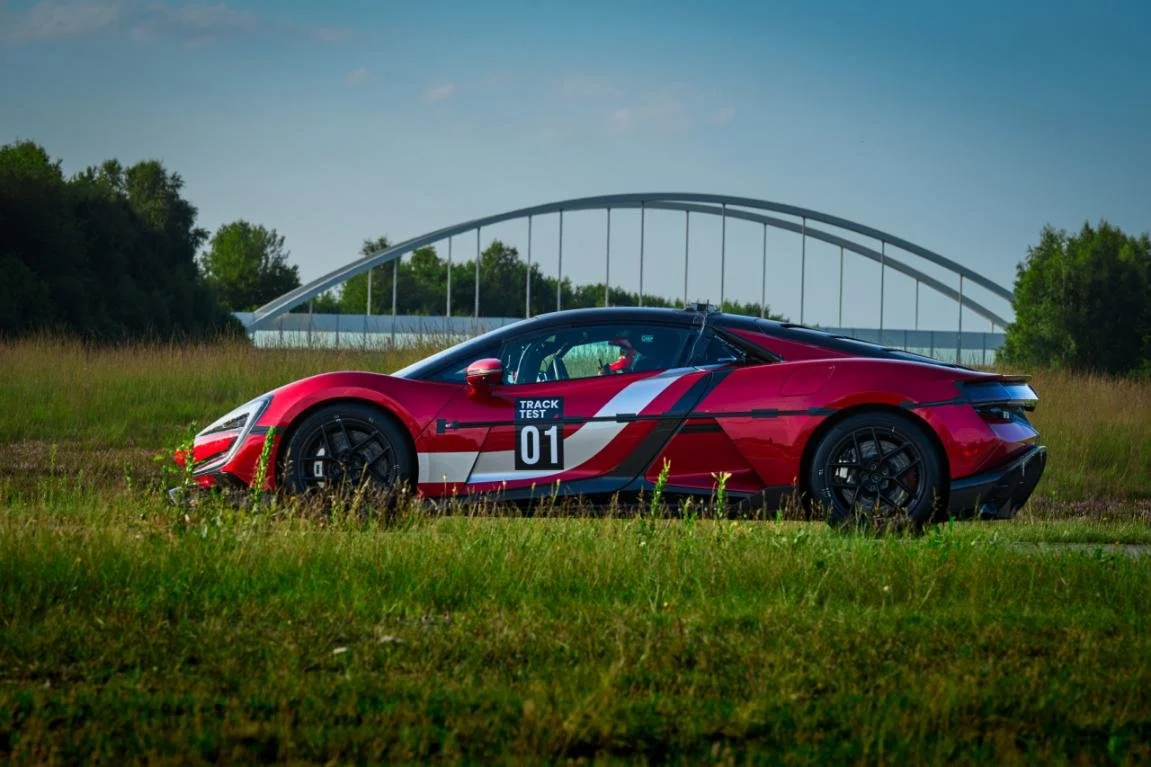
Image: BYD Auto Industry Co., Ltd
The Yangwang U9 Track Edition enters a segment that, until recently, was defined almost exclusively by European and a handful of American hypercar manufacturers. In terms of price, the U9 sits in an entirely different bracket—well below the traditional million-dollar threshold. Yet its technology, power output and engineering ambitions place it in direct ideological competition with hypercars costing five times as much. This creates a unique positioning: a car that delivers hypercar-level engineering without the hypercar-level financial barrier.
From a market strategy perspective, BYD is not attempting to replicate the exclusivity model of Pagani or Koenigsegg. Instead, it is positioning Yangwang as a technological disruptor—a brand that challenges the established hierarchy through innovation and scale rather than heritage. BYD controls its entire supply chain, has unparalleled battery production capacity, and possesses the industrial muscle to bring advanced electric technologies into segments previously insulated by limited production and long development cycles. The U9 Track Edition demonstrates that BYD is fully aware of its advantage and intends to use it.
The global impact is difficult to overstate. For decades, Western hypercar brands have operated with minimal competitive pressure from Asia. Japan dominated sports cars, but never the hypercar class. Now China is entering with a product that does not merely compete—it reframes expectations. If an EV costing a fraction of traditional hypercars can deliver track-grade performance and over 3,000 horsepower, the competitive standards for the entire segment change overnight.
It also shifts the conversation around value. The U9 challenges the assumption that extreme performance must come with extreme pricing. It questions whether legacy brands can justify their costs purely through craftsmanship and exclusivity when technological performance metrics become the primary differentiator.
Looking ahead, the U9 Track Edition is likely only the beginning. BYD’s growing expertise in vertical integration, electric drivetrains and intelligent vehicle systems gives Yangwang a platform to scale upward into even more advanced projects. If the U9 gains international recognition for its performance credibility, it may trigger a new phase of global competition—one where Chinese manufacturers play a leading, not supporting, role.
In short, the U9 Track Edition is not merely entering the hypercar conversation—it is disrupting it. And the established players will have to respond.
Affiliate Disclosure
Disclosure: Some of the links on this website are affiliate links. This means that if you click on one of these links and make a purchase, we may earn a small commission at no extra cost to you.
We only recommend products and services that we trust or that are directly relevant to our content. Affiliate earnings help us keep this platform independent and of high quality.